
2.6K
Downloads
103
Episodes
I am Andrew Allen and I talk about history. Here is a link to my Patreon if you want to support me. https://www.patreon.com/user?u=50989530
Episodes
Wednesday Dec 21, 2022
Wednesday Dec 21, 2022
The Confederation Period lasted from 1783 to 1789. Following the end of the American Revolution in 1783, the newly independent states retained their sovereignty but were part of a confederation of states with a weak federal government. After it became clear that the confederation could not handle the challenges facing the states, a convention was held in Philadelphia which produced a constitution that created a new nation with a stronger federal government. Episode Two explains that Secretary of Foreign Affairs John Jay's failure to conclude a treaty with Spain had confirmed to many American political leaders that the Articles of Confederation were fatally flawed, and a more powerful federal government was required. Hoping to build a closer union, James Madison used a failed convention at Annapolis, Maryland as an opportunity to call for a larger convention to be held in Philadelphia next year.
Cast of Characters:
George Washington- former Commander in Chief of the Continental Army, former delegate from Virginia to the Continental Congress
Benjamin Franklin-President of Pennsylvania, former minister to France, former Postmaster General, signer of the Declaration of Independence
John Jay-Secretary of Foreign Affairs, former President of the Continental Congress and former Minister to Spain
James Madison-delegate from Virginia to the Confederation Congress
Alexander Hamilton-member of the New York State Legislature, former aide to General George Washington, commander of the Continental Army
Charles Pinckney-delegate from South Carolina to the Confederation Congress
Henry Knox-Secretary of War, former major-general in the Continental Army
Sources:
Franklin & Washington: The Founding Partnership-Edward J. Larson
Founding Finance: How Debt, Speculation, Foreclosures, Protests, and Crackdowns Made Us a Nation-William Hogeland
The Age of Federalism: The Early American Republic, 1788-1800-Stanley Elkins & Eric McKitrick
The Quartet: Orchestrating the Second American Revolution, 1783-1789-Joseph J. Ellis
American Creation-Joseph J. Ellis
The Framers' Coup: The Making of the United States Constitution-Michael J. Klarman
Unruly Americans and the Origins of the Constitution-Woody Holton
The Return of George Washington: Uniting the States, 1783-1789-Edward J. Larson
Washington: A Life-Ron Chernow
His Excellency: George Washington-Joseph J. Ellis
George Washington: A Life-Willard Sterne Randall
Radical Hamilton: Economic Lessons from a Misunderstood Founder-Christian Parenti
Alexander Hamilton-Ron Chernow
Alexander Hamilton: A Life-Willard Sterne Randall
James Madison: A Biography-Ralph Ketcham
Robert Morris: Financier of the American Revolution-Charles Rappleye
The Glorious Cause: The American Revolution, 1763-1789-Robert Middlekauff
The Forging of the Union 1781-1789-Richard B. Morris
Image Credit:
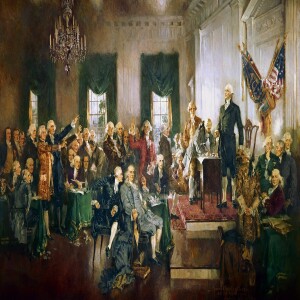
Scene at the Signing of the Constitution of the United States, by Howard Chandler Christy (1940) - The Indian Reporter, Public Domain, https://commons.wikimedia.org/w/index.php?curid=662340
Wednesday Dec 14, 2022
Wednesday Dec 14, 2022
The Confederation Period lasted from 1783 to 1789. Following the end of the American Revolution in 1783, the newly independent states retained their sovereignty but were part of a confederation of states with a weak federal government. After it became clear that the confederation could not handle the challenges facing the states, a convention was held in Philadelphia which produced a constitution that created a new nation with a stronger federal government. Episode One explains that the newly independent states had to deal with Britain's attempt to strangle their economy while struggling to pay off the debts from the war. Making matters worse, resentment was brewing in the frontier regions, which wanted to form their own states because they felt they were neglected by the existing states. So, the states had won their freedom but faced problems that the government could not handle.
Cast of Characters:
Benjamin Franklin-President of Pennsylvania, former minister to France, former Postmaster General, signer of the Declaration of Independence
Robert Morris-businessman, former Superintendent of Finance, signer of the Declaration of Independence
James Wilson-lawyer, signer of the Declaration of Independence
Henry Knox-Secretary of War, former major-general in the Continental Army
Arthur St. Clair-President of the Confederation Congress, former major-general in the Continental Army
William Duer-secretary of the Confederation's Treasury Board
Thomas Jefferson-Minister to France, former governor of Virginia and signer of the Declaration of Independence
Sources:
Franklin & Washington: The Founding Partnership-Edward J. Larson
Founding Finance: How Debt, Speculation, Foreclosures, Protests, and Crackdowns Made Us a Nation-William Hogeland
The Age of Federalism: The Early American Republic, 1788-1800-Stanley Elkins & Eric McKitrick
The Quartet: Orchestrating the Second American Revolution, 1783-1789-Joseph J. Ellis
American Creation-Joseph J. Ellis
The Framers' Coup: The Making of the United States Constitution-Michael J. Klarman
Unruly Americans and the Origins of the Constitution-Woody Holton
The Return of George Washington: Uniting the States, 1783-1789-Edward J. Larson
Washington: A Life-Ron Chernow
His Excellency: George Washington-Joseph J. Ellis
George Washington: A Life-Willard Sterne Randall
Radical Hamilton: Economic Lessons from a Misunderstood Founder-Christian Parenti
Alexander Hamilton-Ron Chernow
Alexander Hamilton: A Life-Willard Sterne Randall
James Madison: A Biography-Ralph Ketcham
Robert Morris: Financier of the American Revolution-Charles Rappleye
The Glorious Cause: The American Revolution, 1763-1789-Robert Middlekauff
The Forging of the Union 1781-1789-Richard B. Morris
Image Credit:
Scene at the Signing of the Constitution of the United States, by Howard Chandler Christy (1940) - The Indian Reporter, Public Domain, https://commons.wikimedia.org/w/index.php?curid=662340
Wednesday Dec 07, 2022
Wednesday Dec 07, 2022
The Confederation Period lasted from 1783 to 1789. Following the end of the American Revolution in 1783, the newly independent states retained their sovereignty but were part of a confederation of states with a weak federal government. After it became clear that the confederation could not handle the challenges facing the states, a convention was held in Philadelphia which produced a constitution that created a new nation with a stronger federal government.
Image Credit:
Scene at the Signing of the Constitution of the United States, by Howard Chandler Christy (1940) - The Indian Reporter, Public Domain, https://commons.wikimedia.org/w/index.php?curid=662340
Wednesday Jul 20, 2022
Wednesday Jul 20, 2022
The Mexican Revolution lasted from 1910 to 1920. Although Francisco Madero managed to overthrow the dictator Porfiro Diaz, he proved to be an ineffective president, who soon lost power. A succession of generals and rebel leaders struggled to gain the president's chair, but the fighting merely grew more destructive until Alvaro Obregon emerged as the victor in 1920. Part XIV explores Obregon's negotiation with the American government, the end of Pancho Villa, the Headless Revolt, the Cristeros War and the end of the revolution.
Cast of Characters:
Alvaro Obregon-President of Mexico, formerly a leading general in Carranza's Constitutionalist army
Plutarco Elias Calles-Secretary of the Interior, key ally of Obregon, formerly governor of Sonora, Secretary of Industry, Commerce and Labor under President Carranza
Adolfo de la Huerta- Secretary of the Treasury, key ally of Obregon, formerly governor of Sonora
Francisco Villa-rebel leader in Chihuahua, his followers are called villistas
Saturnino Cedillo-dominant leader in San Luis Potosi, his followers are called cedillistas
Manuel Palaez-rebel leader in Tampico, funded by oil companies in exchange for security, exiled by Obregon
Warren Harding-president of the US from 1921 to 1923
Calvin Coolidge-Harding's vice-president, succeeded him in 1923
Salvador Alvarado-former governor of Yucatan, member of the Sonoran faction
Manuel Dieguez-former governor of Jalisco, member of the Sonoran faction
Sources:
Villa and Zapata: A Biography of the Mexican Revolution-Frank McLynn
The Mexican Revolution: Volumes I & II-Alan Knight
The Mexican Revolution 1910-1940-Michael J. Gonzales
Mexico: Biography of Power, A History of Modern Mexico, 1810-1996-Enrique Krauze, translated by Hank Heifetz
Empire and Revolution: The Americans in Mexico since the Civil War-John Mason Hart
Revolutionary Mexico: The Coming and Process of the Mexican Revolution
The Life and Times of Pancho Villa-Friedrich Katz
Centaur of the North: Francisco Villa, the Mexican Revolution, and Northern Mexico
Alvaro Obregon: Power and Revolution in Mexico, 1911-1920-Linda B. Hall
The Last Caudillo: Alvar Obregon and the Mexican Revolution-Jurgen Buchenau
The Secret War in Mexico: Europe, the United States and the Mexican Revolution-Friedrich Katz
Felix Diaz, the Porfirians, and the Mexican Revolution-Peter V. N. Henderson
Oil and Revolution in Mexico-Jonathan C. Brown
Oil, Banks and Politics: The United States and Postrevolutionary Mexico, 1917-1924-Linda B. Hall
Dark Side of Fortune: Triumph and Scandal in the Life of Oil Tycoon Edward L. Doheny-Margaret Leslie Davis
Wilson-A. Scott Berg
Image Credit:
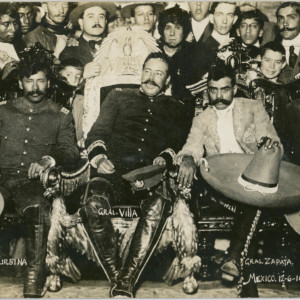
Dec 6 1914 General Tomás Urbina, General Pancho Villa and General Emiliano Zapata, Creator: Casasola, Agustín Víctor, 1874-1938, Elmer and Diane Powell collection on Mexico and the Mexican Revolution, DeGolyer Library, Southern Methodist University, Wikimedia Commons
Wednesday Apr 27, 2022
Wednesday Apr 27, 2022
The Mexican Revolution lasted from 1910 to 1920. Although Francisco Madero managed to overthrow the dictator Porfiro Diaz, he proved to be an ineffective president, who soon lost power. A succession of generals and rebel leaders struggled to gain the president's chair, but the fighting merely grew more destructive until Alvaro Obregon emerged as the victor in 1920. Part XIII explores Obrego's efforts to rebuild Mexico, including negotiating peace with all of the rebel factions. In addition, he had to deal with American refusal to recognize his regime.
Cast of Characters:
Alvaro Obregon-President of Mexico, formerly a leading general in Carranza's Constitutionalist army
Benjamin Hill-Secretary of War, key ally of Obregon, formerly leading general in Carranza's Constitutionalist Army
Plutarco Elias Calles-Secretary of the Interior, key ally of Obregon, formerly governor of Sonora, Secretary of Industry, Commerce and Labor under President Carranza
Adolfo de la Huerta- Secretary of the Treasury, key ally of Obregon, formerly governor of Sonora
Francisco Villa-rebel leader in Chihuahua, his followers are called villistas
Gildardo Magana-Emilano Zapata's successor as leader of the zapatistas
Felix Diaz-repeat rebel, Porfiro Diaz's nephew, his followers are called felicistas
Manuel Palaez-rebel leader in Tampico, funded by oil companies in exchange for security
Sources:
Villa and Zapata: A Biography of the Mexican Revolution-Frank McLynn
The Mexican Revolution: Volumes I & II-Alan Knight
The Mexican Revolution 1910-1940-Michael J. Gonzales
Mexico: Biography of Power, A History of Modern Mexico, 1810-1996-Enrique Krauze, translated by Hank Heifetz
Empire and Revolution: The Americans in Mexico since the Civil War-John Mason Hart
Revolutionary Mexico: The Coming and Process of the Mexican Revolution
The Life and Times of Pancho Villa-Friedrich Katz
Centaur of the North: Francisco Villa, the Mexican Revolution, and Northern Mexico
Alvaro Obregon: Power and Revolution in Mexico, 1911-1920-Linda B. Hall
The Last Caudillo: Alvar Obregon and the Mexican Revolution-Jurgen Buchenau
The Secret War in Mexico: Europe, the United States and the Mexican Revolution-Friedrich Katz
Felix Diaz, the Porfirians, and the Mexican Revolution-Peter V. N. Henderson
Oil and Revolution in Mexico-Jonathan C. Brown
Oil, Banks and Politics: The United States and Postrevolutionary Mexico, 1917-1924-Linda B. Hall
Dark Side of Fortune: Triumph and Scandal in the Life of Oil Tycoon Edward L. Doheny-Margaret Leslie Davis
Wilson-A. Scott Berg
Image Credit:
Dec 6 1914 General Tomás Urbina, General Pancho Villa and General Emiliano Zapata, Creator: Casasola, Agustín Víctor, 1874-1938, Elmer and Diane Powell collection on Mexico and the Mexican Revolution, DeGolyer Library, Southern Methodist University, Wikimedia Commons
Wednesday Apr 13, 2022
Wednesday Apr 13, 2022
The Mexican Revolution lasted from 1910 to 1920. Although Francisco Madero managed to overthrow the dictator Porfiro Diaz, he proved to be an ineffective president, who soon lost power. A succession of generals and rebel leaders struggled to gain the president's chair, but the fighting merely grew more destructive until Alvaro Obregon emerged as the victor in 1920. Part XII explores Felix Diaz's surprisingly successful revolt, and the rapid decline in the influence of both Villa and Zapata. However, the key event was Carranza's break with his key general Alvaro Obregon, which has drastic consequences.
Cast of Characters:
Francisco Villa-rebel leader in Chihuahua, his followers are called villistas
Emiliano Zapata-leader of an agrarian movement in Morelos, his followers are called zapatistas
Gildardo Magana-key zapatista adviser
Venustiano Carranza-president of Mexico, former governor of Coahuila, and leader of the Constitutional movement against Huerta
Alvaro Obregon-a leading general in Carranza's Constitutionalist army
Felix Diaz-repeat rebel, Porfiro Diaz's nephew
Manuel Palaez-rebel leader in Tampico, funded by oil companies in exchange for security
Felipe Angeles-Pancho Villa's leading general, former general in the federal army
Pablo Gonzalez-a leading general in Carranza's Constitutionalist army
Sources:
Villa and Zapata: A Biography of the Mexican Revolution-Frank McLynn
The Mexican Revolution: Volumes I & II-Alan Knight
Mexico: Biography of Power, A History of Modern Mexico, 1810-1996-Enrique Krauze, translated by Hank Heifetz
The Mexican Revolution 1910-1940-Michael J. Gonzales
Empire and Revolution: The Americans in Mexico since the Civil War-John Mason Hart
Revolutionary Mexico: The Coming and Process of the Mexican Revolution
The Life and Times of Pancho Villa-Friedrich Katz
Centaur of the North: Francisco Villa, the Mexican Revolution, and Northern Mexico
Emiliano Zapata: Revolution and Betrayal in Mexico-Samuel Brunk
Zapata and the Mexican Revolution-John Womack, Jr.
Ranchero Revolt: The Mexican Revolution in Guerrero-Ian Jacobs
Venustaino Carranza's Nationalist Struggle, 1893-1920-Douglas W. Richmond
Alvaro Obregon: Power and Revolution in Mexico, 1911-1920-Linda B. Hall
The Last Caudillo: Alvar Obregon and the Mexican Revolution-Jurgen Buchenau
The Secret War in Mexico: Europe, the United States and the Mexican Revolution-Friedrich Katz
Felix Diaz, the Porfirians, and the Mexican Revolution-Peter V. N. Henderson
Oil and Revolution in Mexico-Jonathan C. Brown
Oil, Banks and Politics: The United States and Postrevolutionary Mexico, 1917-1924-Linda B. Hall
Image Credit:
Dec 6 1914 General Tomás Urbina, General Pancho Villa and General Emiliano Zapata, Creator: Casasola, Agustín Víctor, 1874-1938, Elmer and Diane Powell collection on Mexico and the Mexican Revolution, DeGolyer Library, Southern Methodist University, Wikimedia Commons
Wednesday Apr 06, 2022
Wednesday Apr 06, 2022
The Mexican Revolution lasted from 1910 to 1920. Although Francisco Madero managed to overthrow the dictator Porfiro Diaz, he proved to be an ineffective president, who soon lost power. A succession of generals and rebel leaders struggled to gain the president's chair, but the fighting merely grew more destructive until Alvaro Obregon emerged as the victor in 1920. Part XI examines the convention to draft a new constitution and the surprising return of Felix Diaz as the leader of a large-scale revolt.
Cast of Characters:
Francisco Villa-rebel leader in Chihuahua, his followers are called villistas
Emiliano Zapata-leader of an agrarian movement in Morelos, his followers are called zapatistas
Gildardo Magana-key zapatista adviser
Venustiano Carranza-president of Mexico, former governor of Coahuila, and leader of the Constitutional movement against Huerta
Alvaro Obregon-a leading general in Carranza's Constitutional army
Felix Diaz, Jr-repeat rebel, Porfiro Diaz's nephew
Manuel Pelaez-rebel leader in Tampico, funded by oil companies in exchange for security
Woodrow Wilson-President of the United States
Sources:
Villa and Zapata: A Biography of the Mexican Revolution-Frank McLynn
The Mexican Revolution: Volumes I & II-Alan Knight
Mexico: Biography of Power, A History of Modern Mexico, 1810-1996-Enrique Krauze, translated by Hank Heifetz
Empire and Revolution: The Americans in Mexico since the Civil War-John Mason Hart
Revolutionary Mexico: The Coming and Process of the Mexican Revolution
The Life and Times of Pancho Villa-Friedrich Katz
Centaur of the North: Francisco Villa, the Mexican Revolution, and Northern Mexico
Emiliano Zapata: Revolution and Betrayal in Mexico-Samuel Brunk
Zapata and the Mexican Revolution-John Womack, Jr.
Ranchero Revolt: The Mexican Revolution in Guerrero-Ian Jacobs
Venustaino Carranza's Nationalist Struggle, 1893-1920-Douglas W. Richmond
Alvaro Obregon: Power and Revolution in Mexico, 1911-1920-Linda B. Hall
The Last Caudillo: Alvar Obregon and the Mexican Revolution-Jurgen Buchenau
The Secret War in Mexico: Europe, the United States and the Mexican Revolution-Friedrich Katz
Felix Diaz, the Porfirians, and the Mexican Revolution-Peter V. N. Henderson
Oil and Revolution in Mexico-Jonathan C. Brown
Oil, Banks and Politics: The United States and Postrevolutionary Mexico, 1917-1924-Linda B. Hall
The Zimmermann Telegram-Barbara W. Tuchman
Revolution at Queretaro: The Mexican Constitutional Convention of 1916-1917-E.V. Niemeyer, Jr.
Dark Side of Fortune: Triumph and Scandal in the Life of Oil Tycoon Edward L. Doheny-Margaret Leslie Davis
Image Credit:
Dec 6 1914 General Tomás Urbina, General Pancho Villa and General Emiliano Zapata, Creator: Casasola, Agustín Víctor, 1874-1938, Elmer and Diane Powell collection on Mexico and the Mexican Revolution, DeGolyer Library, Southern Methodist University, Wikimedia Commons
Wednesday Mar 30, 2022
Wednesday Mar 30, 2022
The Mexican Revolution lasted from 1910 to 1920. Although Francisco Madero managed to overthrow the dictator Porfiro Diaz, he proved to be an ineffective president, who soon lost power. A succession of generals and rebel leaders struggled to gain the president's chair, but the fighting merely grew more destructive until Alvaro Obregon emerged as the victor in 1920. Part X explores the fallout from Pancho Villa's raid on Columbus, New Mexico, which led to an American army entering Mexico to hunt Villa, and nearly provoked war between the United States and Mexico.
Cast of Characters:
Francisco Villa-rebel leader in Chihuahua, his followers are called villistas
Emiliano Zapata-leader of an agrarian movement in Morelos, his followers are called zapatistas
Venustiano Carranza-president of Mexico, former governor of Coahuila, and leader of the Constitutional movement against Huerta
Alvaro Obregon-a leading general in Carranza's Constitutional army
Woodrow Wilson-President of the United States
Brigadier-general Jack Pershing-commander of the American force sent into Mexico to hunt Pancho Villa after his raid on Columbus
Sources:
Villa and Zapata: A Biography of the Mexican Revolution-Frank McLynn
The Mexican Revolution: Volumes I & II-Alan Knight
Mexico: Biography of Power, A History of Modern Mexico, 1810-1996-Enrique Krauze, translated by Hank Heifetz
Empire and Revolution: The Americans in Mexico since the Civil War-John Mason Hart
Revolutionary Mexico: The Coming and Process of the Mexican Revolution
The Life and Times of Pancho Villa-Friedrich Katz
Centaur of the North: Francisco Villa, the Mexican Revolution, and Northern Mexico
The General and the Jaguar: Pershing's Hunt for Pancho Villa, A True Story of Revolution and Revenge-Eileen Welsome
Border Conflict: Villistas, Carrancistas and the Punitive Expedition 1915-1920-Joseph A. Stout, Jr.
Intervention! The United States and the Mexican Revolution 1913-1917-John S.D. Eisenhower
Emiliano Zapata: Revolution and Betrayal in Mexico-Samuel Brunk
Zapata and the Mexican Revolution-John Womack, Jr.
Ranchero Revolt: The Mexican Revolution in Guerrero-Ian Jacobs
Venustaino Carranza's Nationalist Struggle, 1893-1920-Douglas W. Richmond
Alvaro Obregon: Power and Revolution in Mexico, 1911-1920-Linda B. Hall
The Last Caudillo: Alvar Obregon and the Mexican Revolution-Jurgen Buchenau
The Secret War in Mexico: Europe, the United States and the Mexican Revolution-Friedrich Katz
Image Credit:
Dec 6 1914 General Tomás Urbina, General Pancho Villa and General Emiliano Zapata, Creator: Casasola, Agustín Víctor, 1874-1938, Elmer and Diane Powell collection on Mexico and the Mexican Revolution, DeGolyer Library, Southern Methodist University, Wikimedia Commons
Wednesday Mar 23, 2022
Wednesday Mar 23, 2022
The Mexican Revolution lasted from 1910 to 1920. Although Francisco Madero managed to overthrow the dictator Porfiro Diaz, he proved to be an ineffective president, who soon lost power. A succession of generals and rebel leaders struggled to gain the president's chair, but the fighting merely grew more destructive until Alvaro Obregon emerged as the victor in 1920. Part IX explores the civil war between Pancho Villa and Venustiano Carranza. Given Villa's alliance with Zapata, he should have been unstoppable, but the alliance was far from solid, and Carranza's top general Obregon proved to be very effective.
Cast of Characters:
Francisco Villa-rebel leader in Chihuahua, his followers are called villistas
Emiliano Zapata-leader of an agrarian movement in Morelos, his followers are called zapatistas
Victoriano Huerta-a general in the federal army, who led a coup against Madero and appointed himself president, but was forced into exile, his followers are called huertistas
Pazqual Orozco-primary rebel leader in Chihuahua against Diaz, failed rebel against Madero, his followers are called orozquistas
Venustiano Carranza-governor of Coahuila, former minister of war and leader of the Constitutional movement against Huerta, his followers are called carrancistas
Alvaro Obregon-a leading general in Carranza's Constitutional army
Felipe Angeles-a general in the federal army, who was loyal to Francisco Madero, and then became Villa's leading general
Roque Gonzalez Garza-villista general, Gutierrez's successor as president
Woodrow Wilson-president of the United States
Sources:
Villa and Zapata: A Biography of the Mexican Revolution-Frank McLynn
The Mexican Revolution: Volumes I & II-Alan Knight
The Mexican Revolution 1910-1940-Michael J. Gonzales
Mexico: Biography of Power, A History of Modern Mexico, 1810-1996-Enrique Krauze, translated by Hank Heifetz
Empire and Revolution: The Americans in Mexico since the Civil War-John Mason Hart
Revolutionary Mexico: The Coming and Process of the Mexican Revolution
The Life and Times of Pancho Villa-Friedrich Katz
Centaur of the North: Francisco Villa, the Mexican Revolution, and Northern Mexico
Emiliano Zapata: Revolution and Betrayal in Mexico-Samuel Brunk
Zapata and the Mexican Revolution-John Womack, Jr.
Ranchero Revolt: The Mexican Revolution in Guerrero-Ian Jacobs
Orozco: The Life and Death of a Mexican Revolutionary-Raymond Caballero
Venustaino Carranza's Nationalist Struggle, 1893-1920-Douglas W. Richmond
Alvaro Obregon: Power and Revolution in Mexico, 1911-1920-Linda B. Hall
The Last Caudillo: Alvar Obregon and the Mexican Revolution-Jurgen Buchenau
The Secret War in Mexico: Europe, the United States and the Mexican Revolution-Friedrich Katz
Image Credit:
Dec 6 1914 General Tomás Urbina, General Pancho Villa and General Emiliano Zapata, Creator: Casasola, Agustín Víctor, 1874-1938, Elmer and Diane Powell collection on Mexico and the Mexican Revolution, DeGolyer Library, Southern Methodist University, Wikimedia Commons
Wednesday Mar 16, 2022
Wednesday Mar 16, 2022
The Mexican Revolution lasted from 1910 to 1920. Although Francisco Madero managed to overthrow the dictator Porfiro Diaz, he proved to be an ineffective president, who soon lost power. A succession of generals and rebel leaders struggled to gain the president's chair, but the fighting merely grew more destructive until Alvaro Obregon emerged as the victor in 1920. Part VIII examines the aftermath of Heurta's defeat as the various factions met in the Convention of Aguascalientes to resolve their differences and form a new government, hoping to avoid a civil war.
Cast of Characters:
Francisco Villa-rebel leader in Chihuahua, his followers are called villistas
Emiliano Zapata-leader of an agrarian movement in Morelos, his followers are called zapatistas
Victoriano Huerta-a general in the federal army, who led a coup against Madero and appointed himself president but was forced into exile
Venustiano Carranza-governor of Coahuila, former minister of war and leader of the Constitutional movement against Huerta, his followers are called carrancistas
Alvaro Obregon-a leading general in Carranza's Constitutional army
Felipe Angeles-a general in the federal army, who was loyal to Francisco Madero, and then became Villa's leading general
Eulalio Gutierrez-carracista general from San Luis Potosi, elected provisional president during the Convention of Aguascalientes
Roque Gonzalez Garza-villista general, Gutierrez's successor as president
Sources:
Villa and Zapata: A Biography of the Mexican Revolution-Frank McLynn
The Mexican Revolution: Volumes I & II-Alan Knight
Mexico: Biography of Power, A History of Modern Mexico, 1810-1996-Enrique Krauze, translated by Hank Heifetz
Empire and Revolution: The Americans in Mexico since the Civil War-John Mason Hart
Revolutionary Mexico: The Coming and Process of the Mexican Revolution
The Life and Times of Pancho Villa-Friedrich Katz
Centaur of the North: Francisco Villa, the Mexican Revolution, and Northern Mexico
Emiliano Zapata: Revolution and Betrayal in Mexico-Samuel Brunk
Zapata and the Mexican Revolution-John Womack, Jr.
Ranchero Revolt: The Mexican Revolution in Guerrero-Ian Jacobs
Orozco: The Life and Death of a Mexican Revolutionary-Raymond Caballero
Venustaino Carranza's Nationalist Struggle, 1893-1920-Douglas W. Richmond
Alvaro Obregon: Power and Revolution in Mexico, 1911-1920-Linda B. Hall
The Last Caudillo: Alvar Obregon and the Mexican Revolution-Jurgen Buchenau
Image Credit:
Dec 6 1914 General Tomás Urbina, General Pancho Villa and General Emiliano Zapata, Creator: Casasola, Agustín Víctor, 1874-1938, Elmer and Diane Powell collection on Mexico and the Mexican Revolution, DeGolyer Library, Southern Methodist University, Wikimedia Commons