
2.6K
Downloads
103
Episodes
I am Andrew Allen and I talk about history. Here is a link to my Patreon if you want to support me. https://www.patreon.com/user?u=50989530
Episodes
Wednesday Mar 09, 2022
Wednesday Mar 09, 2022
The Mexican Revolution lasted from 1910 to 1920. Although Francisco Madero managed to overthrow the dictator Porfiro Diaz, he proved to be an ineffective president, who soon lost power. A succession of generals and rebel leaders struggled to gain the president's chair, but the fighting merely grew more destructive until Alvaro Obregon emerged as the victor in 1920. Part VII explains how Huerta's dictatorship was opposed by factions led by Venustiano Carranza, Pancho Villa and Emiliano Zapata, as well as an American occupation of Vera Cruz to protect American oil producers in the region.
Cast of Characters:
Pazqual Orozco-primary rebel leader in Chihuahua against Diaz, failed rebel against Madero, his followers are called orozquistas
Francisco Villa-rebel leader in Chihuahua, his followers are called villistas
Emiliano Zapata-leader of an agrarian movement in Morelos, his followers are called zapatistas
Victoriano Huerta-a general in the federal army, who led a coup against Madero and appointed himself president
Venustiano Carranza-governor of Coahuila, former minister of war and leader of the Constitutional movement against Huerta
Alvaro Obregon-a leading general in Carranza's Constitutional army
Felipe Angeles-a general in the federal army, who was loyal to Francisco Madero, and then became Villa's leading general
Woodrow Wilson-president of the United States
Sources:
Villa and Zapata: A Biography of the Mexican Revolution-Frank McLynn
The Mexican Revolution: Volumes I & II-Alan Knight
Mexico: Biography of Power, A History of Modern Mexico, 1810-1996-Enrique Krauze, translated by Hank Heifetz
Empire and Revolution: The Americans in Mexico since the Civil War-John Mason Hart
Revolutionary Mexico: The Coming and Process of the Mexican Revolution-John Mason Hart
Revolution on the Border: The United States and Mexico, 1910-1920-Linda B. Hall and Don M. Coerver
The Life and Times of Pancho Villa-Friedrich Katz
Centaur of the North: Francisco Villa, the Mexican Revolution, and Northern Mexico
Emiliano Zapata: Revolution and Betrayal in Mexico-Samuel Brunk
Zapata and the Mexican Revolution-John Womack, Jr.
Ranchero Revolt: The Mexican Revolution in Guerrero-Ian Jacobs
Orozco: The Life and Death of a Mexican Revolutionary-Raymond Caballero
Huerta: A Political Portrait-Michael C. Meyer
Venustaino Carranza's Nationalist Struggle, 1893-1920-Douglas W. Richmond
Alvaro Obregon: Power and Revolution in Mexico, 1911-1920-Linda B. Hall
The Last Caudillo: Alvar Obregon and the Mexican Revolution-Jurgen Buchenau
The Secret War in Mexico: Europe, the United States and the Mexican Revolution-Friedrich Katz
Dark Side of Fortune: Triumph and Scandal in the Life of Oil Tycoon Edward L. Doheny-Margaret Leslie Davis
Image Credit:
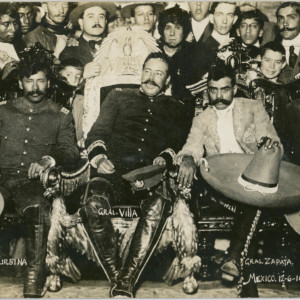
Dec 6 1914 General Tomás Urbina, General Pancho Villa and General Emiliano Zapata, Creator: Casasola, Agustín Víctor, 1874-1938, Elmer and Diane Powell collection on Mexico and the Mexican Revolution, DeGolyer Library, Southern Methodist University, Wikimedia Commons
Wednesday Mar 02, 2022
Wednesday Mar 02, 2022
The Mexican Revolution lasted from 1910 to 1920. Although Francisco Madero managed to overthrow the dictator Porfiro Diaz, he proved to be an ineffective president, who soon lost power. A succession of generals and rebel leaders struggled to gain the president's chair, but the fighting merely grew more destructive until Alvaro Obregon emerged as the victor in 1920. Part VI shows how General Huerta took advantage of an attempted coup by Bernardo Reyes and Felix Diaz, Jr and seized power, but Madero's death and Huerta's blunt repression sparks a series of revolts.
Cast of Characters:
Francisco Madero Jr.-president and member of the wealthy Madero clan, his followers are called maderistas
Pazqual Orozco-primary rebel leader in Chihuahua against Diaz, failed rebel against Madero, his followers are called orozquistas
Francisco Villa-rebel leader in Chihuahua, his followers are called villistas
Emiliano Zapata-leader of an agrarian movement in Morelos, his followers are called zapatistas
Venustiano Carranza-governor of Coahuila, former minister of war and leader of the Constitutional movement against Huerta
Francisco Leon de la Barra-former foreign minister and interim president following Porfiro Diaz's resignation
Victoriano Huerta-a general in the federal army, who led a coup against Madero and appointed himself president
Bernardo Reyes-former general, former Minister of War, former governor of Nuevo Leon and failed rebel, his followers are called reyistas
Felix Diaz Jr.-Porfiro Diaz's nephew, general in the federal army and failed coup leader, his followers are called felicistas
Henry Wilson-American ambassador to Mexico
Sources:
Villa and Zapata: A Biography of the Mexican Revolution-Frank McLynn
The Mexican Revolution: Volumes I & II-Alan Knight
Mexico: Biography of Power, A History of Modern Mexico, 1810-1996-Enrique Krauze, translated by Hank Heifetz
Francisco I. Madero: Apostle of Mexican Democracy-Stanley R. Ross
Empire and Revolution: The Americans in Mexico since the Civil War-John Mason Hart
Revolutionary Mexico: The Coming and Process of the Mexican Revolution
The Life and Times of Pancho Villa-Friedrich Katz
Centaur of the North: Francisco Villa, the Mexican Revolution, and Northern Mexico
Emiliano Zapata: Revolution and Betrayal in Mexico-Samuel Brunk
Zapata and the Mexican Revolution-John Womack, Jr.
Ranchero Revolt: The Mexican Revolution in Guerrero-Ian Jacobs
Agrarian Warlord: Saturnino Cedillo and the Mexican Revolution in San Luis Potosi-Dudley Ankerson
Orozco: The Life and Death of a Mexican Revolutionary-Raymond Caballero
In the Absence of Don Porfirio: Francisco Leon de la Barra and the Mexican Revolution-Peter Henderson
Huerta: A Political Portrait-Michael C. Meyer
Felix Diaz, the Porfirians, and the Mexican Revolution-Peter V. N. Henderson
Image Credit:
Dec 6 1914 General Tomás Urbina, General Pancho Villa and General Emiliano Zapata, Creator: Casasola, Agustín Víctor, 1874-1938, Elmer and Diane Powell collection on Mexico and the Mexican Revolution, DeGolyer Library, Southern Methodist University, Wikimedia Commons
Wednesday Feb 23, 2022
Wednesday Feb 23, 2022
The Mexican Revolution lasted from 1910 to 1920. Although Francisco Madero managed to overthrow the dictator Porfiro Diaz, he proved to be an ineffective president, who soon lost power. A succession of generals and rebel leaders struggled to gain the president's chair, but the fighting merely grew more destructive until Alvaro Obregon emerged as the victor in 1920. Part V presents newly elected President Madero's attempt to find a peaceful solution to Emiliano Zapata's agrarian insurrection and deal with the danger of a revolt by Pazqual Orozco, a key leader during the uprising against Porfiro Diaz.
Cast of Characters:
Francisco Madero Jr.-president, leader of revolt against Porfiro Diaz, former presidential candidate and member of the wealthy Madero clan
Pazqual Orozco-leader of anti-Madero revolt, formerly primary rebel leader in Chihuahua against Diaz
Francisco Villa-rebel leader in Chihuahua
Emiliano Zapata-leader of an agrarian movement in Morelos
Francisco Leon de la Barra-interim president, former Minister of Foreign Relations
Victoriano Huerta-general in the federal army
Felipe Angeles-general in the federal army
Emiliano Vazquez Gomez-former Minister of the Interior, and brother of Francisco Vazquez Gomez, Madero's first vice-presidential running mate
Sources:
Villa and Zapata: A Biography of the Mexican Revolution-Frank McLynn
The Mexican Revolution: Volumes I & II-Alan Knight
Mexico: Biography of Power, A History of Modern Mexico, 1810-1996-Enrique Krauze, translated by Hank Heifetz
Francisco I. Madero: Apostle of Mexican Democracy-Stanley R. Ross
Empire and Revolution: The Americans in Mexico since the Civil War-John Mason Hart
Revolutionary Mexico: The Coming and Process of the Mexican Revolution
The Life and Times of Pancho Villa-Friedrich Katz
Centaur of the North: Francisco Villa, the Mexican Revolution, and Northern Mexico
Emiliano Zapata: Revolution and Betrayal in Mexico-Samuel Brunk
Zapata and the Mexican Revolution-John Womack, Jr.
Ranchero Revolt: The Mexican Revolution in Guerrero-Ian Jacobs
Orozco: The Life and Death of a Mexican Revolutionary-Raymond Caballero
In the Absence of Don Porfirio: Francisco Leon de la Barra and the Mexican Revolution-Peter Henderson
Huerta: A Political Portrait-Michael C. Meyer
Image Credit:
Dec 6 1914 General Tomás Urbina, General Pancho Villa and General Emiliano Zapata, Creator: Casasola, Agustín Víctor, 1874-1938, Elmer and Diane Powell collection on Mexico and the Mexican Revolution, DeGolyer Library, Southern Methodist University, Wikimedia Commons
Wednesday Feb 16, 2022
Wednesday Feb 16, 2022
The Mexican Revolution lasted from 1910 to 1920. Although Francisco Madero managed to overthrow the dictator Porfiro Diaz, he proved to be an ineffective president, who soon lost power. A succession of generals and rebel leaders struggled to gain the president's chair, but the fighting merely grew more destructive until Alvaro Obregon emerged as the victor in 1920. Part IV presents the efforts of reluctant revolutionary Francisco Madero to satisfy the demands of his followers without disrupting the existing social and economic order. Meanwhile, interim president Francisco de la Barra oversees the demobilization of the revolutionaries and the first free presidential election in decades.
Cast of Characters:
Francisco Madero Jr.-leader of revolt against Porfiro Diaz, former presidential candidate and member of the wealthy Madero clan
Pazqual Orozco-primary rebel leader in Chihuahua against Diaz
Abraham Gonzalez-rebel leader in Chihuahua
Emiliano Zapata-leader of an agrarian movement in Morelos
Emilio Vasquez Gomez-Minister of the Interior in the new cabinet, brother of Franciso Vazquez Gomez, Madero's former running mate
Francisco Leon de la Barra-former interim president, former Minister of Foreign Relations
Victoriano Huerta-general in federal army
Bernardo Reyes-former general, former Minister of War, and former governor of Nuevo Leon
Felix Diaz Jr.-Porfiro Diaz's nephew
Sources:
Villa and Zapata: A Biography of the Mexican Revolution-Frank McLynn
The Mexican Revolution: Volumes I & II-Alan Knight
Mexico: Biography of Power, A History of Modern Mexico, 1810-1996-Enrique Krauze, translated by Hank Heifetz
Francisco I. Madero: Apostle of Mexican Democracy-Stanley R. Ross
Empire and Revolution: The Americans in Mexico since the Civil War-John Mason Hart
Revolutionary Mexico: The Coming and Process of the Mexican Revolution
The Life and Times of Pancho Villa-Friedrich Katz
Centaur of the North: Francisco Villa, the Mexican Revolution, and Northern Mexico
Emiliano Zapata: Revolution and Betrayal in Mexico-Samuel Brunk
Zapata and the Mexican Revolution-John Womack, Jr.
Ranchero Revolt: The Mexican Revolution in Guerrero-Ian Jacobs
Orozco: The Life and Death of a Mexican Revolutionary-Raymond Caballero
In the Absence of Don Porfirio: Francisco Leon de la Barra and the Mexican Revolution-Peter Henderson
Huerta: A Political Portrait-Michael C. Meyer
Felix Diaz, the Porfirians, and the Mexican Revolution-Peter V. N. Henderson
Image Credit:
Dec 6 1914 General Tomás Urbina, General Pancho Villa and General Emiliano Zapata, Creator: Casasola, Agustín Víctor, 1874-1938, Elmer and Diane Powell collection on Mexico and the Mexican Revolution, DeGolyer Library, Southern Methodist University, Wikimedia Commons
Wednesday Feb 09, 2022
Wednesday Feb 09, 2022
The Mexican Revolution lasted from 1910 to 1920. Although Francisco Madero managed to overthrow the dictator Porfiro Diaz, he proved to be an ineffective president, who soon lost power. A succession of generals and rebel leaders struggled to gain the president's chair, but the fighting merely grew more destructive until Alvaro Obregon emerged as the victor in 1920. Part III explains how Francisco Madero's middle class supporters were easily crushed, but rebel leaders like Pazqual Orozco, Pancho Villa and Emiliano Zapata transformed Madero's polite, orderly revolt into a mass uprising that threatened to destroy the established social order.
Cast of Characters:
Porfiro Diaz-President of Mexico
Jose Yves Limantour-Minister of Finance, leader of the Cientificos faction
Luis Terrazas-former governor of Chihuahua, one of the wealthiest men in Mexico, head of the powerful Terraza-Creel clan
Enrique Creel-Minister of Foreign Relations and Luis Terrazas' son-in-law
Francisco Madero Jr.-presidential candidate and member of the wealthy Madero clan
Franciso Vazquez Gomez-Madero's running mate, former personal physician to Porfiro Diaz
Pazqual Orozco-primary rebel leader in Chihuahua against Diaz
Francisco Villa-rebel leader in Chihuahua
Emiliano Zapata-leader of an agrarian movement in Morelos
Sources:
Villa and Zapata: A Biography of the Mexican Revolution-Frank McLynn
The Mexican Revolution: Volumes I & II-Alan Knight
Mexico: Biography of Power, A History of Modern Mexico, 1810-1996-Enrique Krauze, translated by Hank Heifetz
Porfirio Diaz-Paul Garner
Francisco I. Madero: Apostle of Mexican Democracy-Stanley R. Ross
Empire and Revolution: The Americans in Mexico since the Civil War-John Mason Hart
Revolutionary Mexico: The Coming and Process of the Mexican Revolution-John Mason Hart
The Life and Times of Pancho Villa-Friedrich Katz
Centaur of the North: Francisco Villa, the Mexican Revolution, and Northern Mexico
Emiliano Zapata: Revolution and Betrayal in Mexico-Samuel Brunk
Zapata and the Mexican Revolution-John Womack, Jr.
Ranchero Revolt: The Mexican Revolution in Guerrero-Ian Jacobs
Orozco: The Life and Death of a Mexican Revolutionary-Raymond Caballero
In the Absence of Don Porfirio: Francisco Leon de la Barra and the Mexican Revolution-Peter Henderson
Image Credit:
Dec 6 1914 General Tomás Urbina, General Pancho Villa and General Emiliano Zapata, Creator: Casasola, Agustín Víctor, 1874-1938, Elmer and Diane Powell collection on Mexico and the Mexican Revolution, DeGolyer Library, Southern Methodist University, Wikimedia Commons
Wednesday Feb 02, 2022
Wednesday Feb 02, 2022
The Mexican Revolution lasted from 1910 and 1920. Although Francisco Madero managed to overthrow the dictator Porfiro Diaz, he proved to be an ineffective president, who soon lost power. A succession of generals and rebel leaders struggled to gain the president's chair, but the fighting merely grew more destructive until Alvaro Obregon emerged as the victor in 1920. Part II presents the presidential campaign of Francisco Madero, the first serious political challenger to the dictatorship of Porfiro Diaz. Refusing to risk losing a fair election, Diaz simply arrested Madero. Denied the possibility of a peaceful regime change, Madero's followers revolted.
Cast of Characters:
Porfiro Diaz-President of Mexico
Jose Yves Limantour-Minister of Finance, leader of the Cientificos faction
Bernardo Reyes-general and former governor of Nuevo Leon, potential successor to Porfiro Diaz
Luis Terrazas-former governor of Chihuahua, one of the wealthiest men in Mexico, head of the powerful Terraza-Creel clan
Enrique Creel-Minister of Foreign Relations and Luis Terrazas' son-in-law
Francisco Madero-presidential candidate and member of the wealthy Madero clan
Franciso Vazquez Gomez-Madero's running mate, former personal physician to Porfiro Diaz
Felix Diaz, Jr.-Porfiro Diaz's nephew
Sources:
Villa and Zapata: A Biography of the Mexican Revolution-Frank McLynn
The Mexican Revolution: Volumes I & II-Alan Knight
Mexico: Biography of Power, A History of Modern Mexico, 1810-1996-Enrique Krauze, translated by Hank Heifetz
Porfirio Diaz-Paul Garner
Francisco I. Madero: Apostle of Mexican Democracy-Stanley R. Ross
Empire and Revolution: The Americans in Mexico since the Civil War-John Mason Hart
Revolutionary Mexico: The Coming and Process of the Mexican Revolution
Agrarian Warlord: Saturnino Cedillo and the Mexican Revolution in San Luis Potosi-Dudley Ankerson
Image Credit:
Dec 6 1914 General Tomás Urbina, General Pancho Villa and General Emiliano Zapata, Creator: Casasola, Agustín Víctor, 1874-1938, Elmer and Diane Powell collection on Mexico and the Mexican Revolution, DeGolyer Library, Southern Methodist University, Wikimedia Commons
Wednesday Jan 26, 2022
Wednesday Jan 26, 2022
The Mexican Revolution lasted from 1910 and 1920. Although Francisco Madero managed to overthrow the dictator Porfiro Diaz, he proved to be an ineffective president, who soon lost power. A succession of generals and rebel leaders struggled to gain the president's chair, but the fighting merely grew more destructive until Alvaro Obregon emerged as the victor in 1920. Part I explains how Porfiro Diaz became dictator of Mexico, and then allowed American and European corporations and financiers to dominate the Mexican economy. While the Mexican elite became rich, the majority of the Mexican population did not share in the prosperity, which fueled resentment.
Cast of Characters:
Porfiro Diaz-President of Mexico
Benito Juarez-President of Mexico during the French Intervention in Mexico, initially an ally, then a rival of Diaz
Sebastian Lerdo-Juarez's successor as president, overthrown by Diaz in a revolt
Jose Yves Limantour-Minister of Finance, leader of the Cientificos faction
Bernardo Reyes-governor of Nuevo Leon, former Minister of War, leader of the anti-cientificos faction
James Stillman-wealthy Texan, partner in several Texan railroads and chairman of National City Bank of New York
Edward Doheny-American oil tycoon who helped create the Mexican oil industry
Sir Weetman Pearson-British engineer who helped create the Mexican oil industry
Sources:
Villa and Zapata: A Biography of the Mexican Revolution-Frank McLynn
The Mexican Revolution: Volumes I & II-Alan Knight
The Mexican Revolution 1910-1940-Michael J. Gonzales
Mexico: Biography of Power, A History of Modern Mexico, 1810-1996-Enrique Krauze, translated by Hank Heifetz
Porfirio Diaz-Paul Garner
Empire and Revolution: The Americans in Mexico since the Civil War-John Mason Hart
Revolutionary Mexico: The Coming and Process of the Mexican Revolution
The Guggenheims: An American Epic-John H. Davis
Oil and Revolution in Mexico-Jonathan C. Brown
Dark Side of Fortune: Triumph and Scandal in the Life of Oil Tycoon Edward L. Doheny-Margaret Leslie Davis
Image Credit:
Dec 6 1914 General Tomás Urbina, General Pancho Villa and General Emiliano Zapata, Creator: Casasola, Agustín Víctor, 1874-1938, Elmer and Diane Powell collection on Mexico and the Mexican Revolution, DeGolyer Library, Southern Methodist University, Wikimedia Commons
Wednesday Jan 19, 2022
Wednesday Jan 19, 2022
The Mexican Revolution lasted from 1910 and 1920. Although Francisco Madero managed to overthrow the dictator Porfiro Diaz, he proved to be an ineffective president, who soon lost power. A succession of generals and rebel leaders struggled to gain the president's chair, but the fighting merely grew more destructive until Alvaro Obregon emerged as the victor in 1920.
Image Credit:
Dec 6 1914 General Tomás Urbina, General Pancho Villa and General Emiliano Zapata
Creator: Casasola, Agustín Víctor, 1874-1938, Elmer and Diane Powell collection on Mexico and the Mexican Revolution, DeGolyer Library, Southern Methodist University, Wikimedia Commons
Wednesday May 05, 2021
Wednesday May 05, 2021
The Cathar Crusade, a crusade against non-violent followers of a different form of Christianity, lasted from 1209 to 1229, and resulted in the conquest of the Toulouse region by the French king, the establishment of papal domination over the Christian church in Europe and the creation of the Papal Inquisition, basically the first secret police. Part VI examines Amaury de Montfort's failure to hold on to his father's territories, the transfer of his claim to King Louis of France, who used the crusade as an excuse to extend Capetian rule into the Languedoc, the extermination of the Cathars as an organized faith and the creation of the Papal Inquisition to prevent the spread of ideas from outside Europe.
Cast of Characters:
Raymond VI-Count of Toulouse
Raymond VII-Count Raymond's heir
Raymond-Roger-Count of Foix
Amaury de Montfort-Simon de Montfort's heir, Viscount of Trencavel
Fulk-Bishop of Toulouse, member of the Cistercian Order
Louis VIII-heir to King Philip II of France, failed claimant to the English throne and king of France
Blanche of Castile-Louis's wife and regent for their son Louis IX following his death
Honorius III-Pope
Gregory IX-Pope, Honorius' successor
Betrand-cardinal of St. Paul and St. John, papal legate
Romano-cardinal and papal legate
Sources:
Kill Them All: Cathars and Carnage in the Albigensian Crusade-Sean McGlynn
Pope Innocent III and His Times-Joseph Clayton
The Popes: A History-John Julius Norwich
The Occitan War: A Military and Political History of the Albigensian Crusade, 1209-1218-Laurence W. Marvin
A Most Holy War: The Albigensian Crusade and the Battle for Christendom-Mark Gregory Pegg
The Perfect Heresy: The Life and Death of the Cathars-Stephen O'Shea
The Albigensian Crusade-Jonathan Sumption
The Medieval World: Europe 1100-1350-Friedrich Heer, translated by Janet Sondheimer
Louis: The French Prince Who Invaded England-Catherine Hanley
Image Credit:
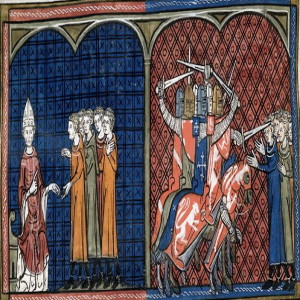
Pope Innocent III excommunicating the Albigensians (left). Massacre against the Albigensians by the Crusaders (right).
By Chroniques de Saint-Denis - http://www.bl.uk/catalogues/illuminatedmanuscripts/ILLUMIN.ASP?Size=mid&IllID=43733, Public Domain, https://commons.wikimedia.org/w/index.php?curid=13305991
Wednesday Apr 07, 2021
Wednesday Apr 07, 2021
The Cathar Crusade, a crusade against non-violent followers of a different form of Christianity, lasted from 1209 to 1229, and resulted in the conquest of the Toulouse region by the French king, the establishment of papal domination over the Christian church in Europe and the creation of the Papal Inquisition, basically the first secret police. Part V covers the efforts of Count Raymond of Toulouse to win the pope's support during the Fourth Lateran Council, the continuation of the crusade and the final defeat of Simon de Montfort.
Cast of Characters:
Simon de Montfort-earl of Leicester, viscount of Trencavel, leader of the crusade
Raymond VI-Count of Toulouse
Raymond VII-Count Raymond's heir
Raymond-Roger-Count of Foix
Fulk-Bishop of Toulouse, member of the Cistercian Order
Innocent III-Pope
Honorius III-Pope, Innocent's successor
Pietro of Benevento-papal legate
Betrand-cardinal of St. Paul and St. John, papal legate
Sources:
Kill Them All: Cathars and Carnage in the Albigensian Crusade-Sean McGlynn
Innocent III: Leader of Europe 1198-1216-Jane Sayers
Pope Innocent III and His Times-Joseph Clayton
The Popes: A History-John Julius Norwich
The Occitan War: A Military and Political History of the Albigensian Crusade, 1209-1218-Laurence W. Marvin
A Most Holy War: The Albigensian Crusade and the Battle for Christendom-Mark Gregory Pegg
The Perfect Heresy: The Life and Death of the Cathars-Stephen O'Shea
The Albigensian Crusade-Jonathan Sumption
The Medieval Crown of Aragon: A Short History-T. N. Bisson
Image Credit:
Pope Innocent III excommunicating the Albigensians (left). Massacre against the Albigensians by the Crusaders (right).
By Chroniques de Saint-Denis - http://www.bl.uk/catalogues/illuminatedmanuscripts/ILLUMIN.ASP?Size=mid&IllID=43733, Public Domain, https://commons.wikimedia.org/w/index.php?curid=13305991